Work · Five concept sites
Five businesses. Five completely different websites.
A stone fabricator, a coffee shop, a touring singer, a plumber and a real estate investment firm. Each site was designed from a blank page around the one thing that business needs a visitor to do next.
The five
Open any one. Everything on it works.
Pick a slab, stir a coffee, play a show, fix a burst pipe, scrub through ten years of a portfolio. Every feature runs in your browser, on a phone as well as a desktop.
-
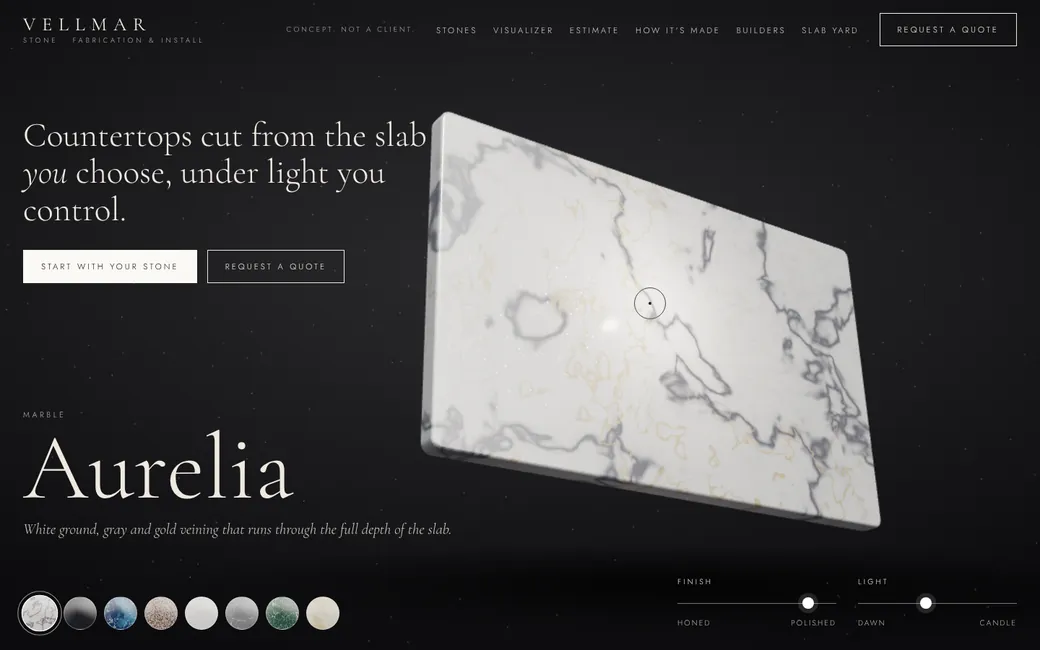 Stone countertop fabricator
Vellmar Stone
Brings in the quote request from a homeowner who has already chosen a slab.
- What works
- Pick a slab, put it on a kitchen, and get a price range from your own measurements.
- How it’s drawn
- Real-time 3D with three.js and custom stone shaders. Your pointer is the light.
-
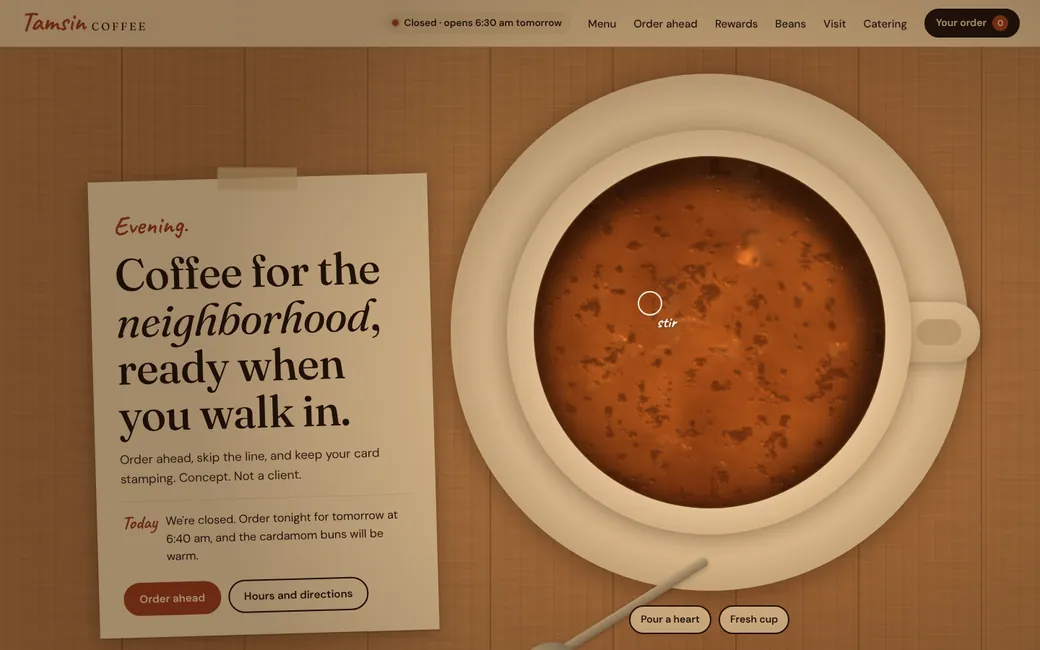 Neighborhood coffee shop
Tamsin Coffee
Turns someone walking past into an order that is ready when they arrive.
- What works
- Order ahead for pickup, and collect stamps toward a free drink.
- How it’s drawn
- A live fluid simulation on the graphics chip. Stir the cup; the light in the room follows the clock.
-
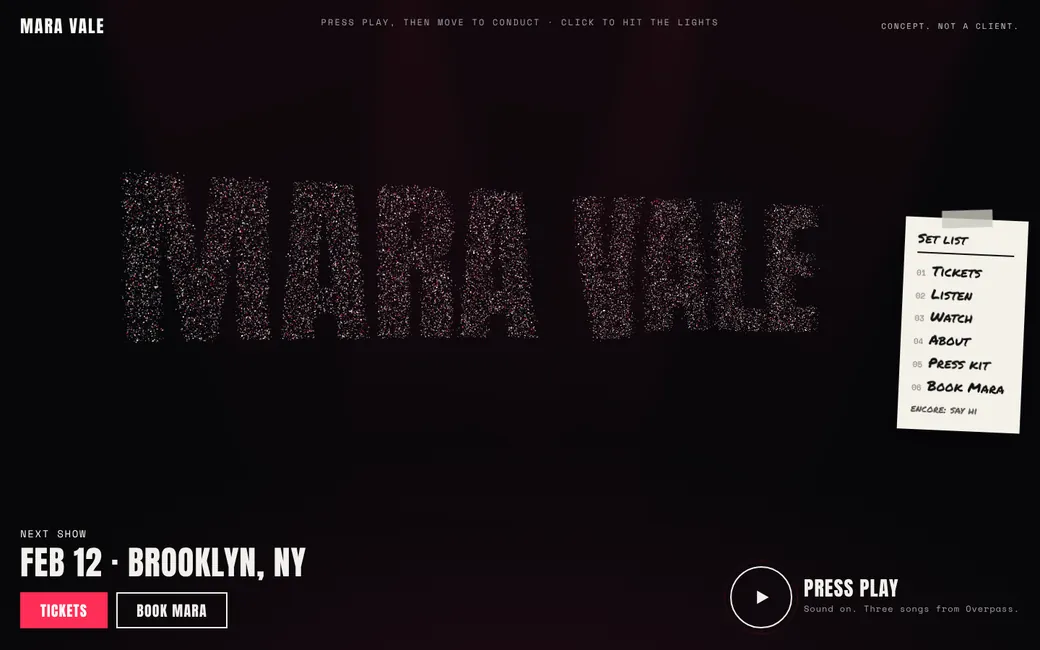 Touring singer
Mara Vale
Sells tickets to fans and books the next show with promoters.
- What works
- Tour dates with tickets, a press kit, and a booking request for promoters.
- How it’s drawn
- Music composed and played live by the browser. The stage lights and a field of particles move to every note.
-
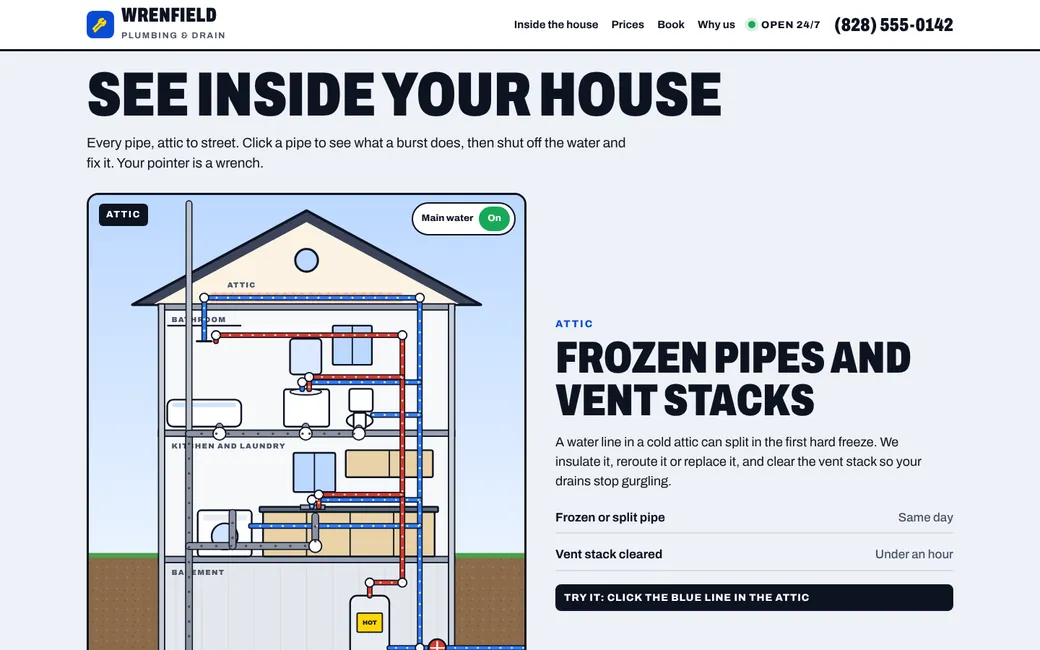 Plumbing and drain company
Wrenfield Plumbing & Drain
Gets the call, with a price range and an arrival window agreed before anyone drives out.
- What works
- Open the house, click a pipe to see what goes wrong, then book a two-hour window.
- How it’s drawn
- A cutaway drawing with water simulated drop by drop. Your pointer is a wrench.
-
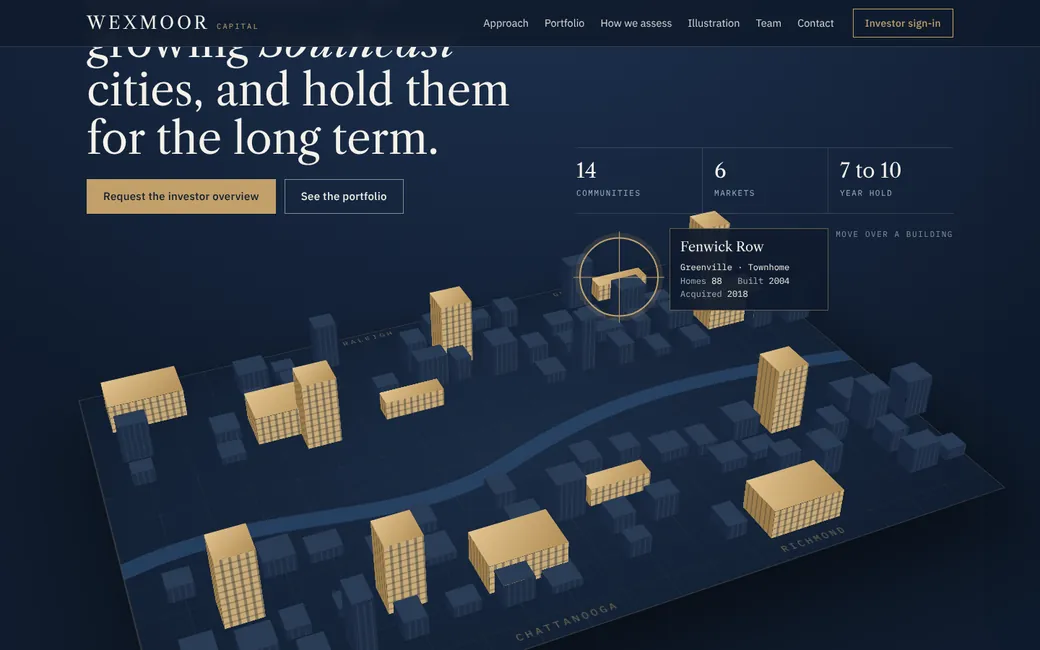 Real estate investment firm
Wexmoor Capital
Opens a conversation with a prospective investor and keeps current ones informed.
- What works
- Drag ten years of a portfolio across a city, open a community, and try the investor portal.
- How it’s drawn
- A 3D city made from CSS alone, with no graphics library. A lens reads each building.
All five businesses are fictional, and each name was checked against real companies before we used it. The pages carry no reviews, results or clients, because none exist, and nothing typed into them is sent anywhere.
No templates
Every business website is its own thing.
A template begins with someone else’s layout and asks your business to fit inside it. We begin with the business: who the customers are, what they need to see before they trust you, and the one action the site exists to produce. The design follows from those answers.
That is why these five share nothing. Each has its own typefaces, colors, layout, navigation and code. A stone fabricator sells on the look of the stone, so its site puts the stone under a light you control. A plumber’s customer has water on the floor, so that site leads with a phone number, a price range and an arrival window.
It also keeps a site lean. Nothing loads that the business doesn’t use, and every page is built to the same standard as this one: fast on a phone, secure, accessible and readable by search engines and AI assistants.
Already have a site
Your platform can stay.
Plenty of businesses run on WordPress, Squarespace, Shopify, Wix or another platform, with staff who already know how to keep it current. That investment counts. We work inside what you have: redesign the pages that carry the business, add the feature that’s missing, connect it to your phones, calendar and records, and fix what makes it slow.
If a platform is genuinely holding the business back, we say so plainly, with what a move would cost and what it would return, and the decision stays yours.
How these were made
Drawn in code, live in your browser.
None of the five uses a photograph, a stock image or a video file. Everything you see is drawn by your own browser while the page runs, on the same graphics hardware that runs games. That keeps the pages light and means every image belongs to the business it was made for.
- Real-time 3D. The stone slabs are generated, polished and lit as you watch, with three.js and shaders written for stone.
- Fluid simulation. The coffee is a physics model of liquid, solved on the graphics chip for every frame.
- Sound made on the page. The singer’s music is synthesized by the browser’s audio engine, and the stage reacts to what it hears.
- Simulated water. The plumbing cutaway moves water through the pipes drop by drop, and stops when you close the valve.
- 3D from styles alone. The investment firm’s city is built from CSS, the same language that sets a page’s colors and type.
Spectacle is a tool, used where it helps the business sell and left out where it doesn’t. Every effect has a plain version for older phones and for visitors who turn motion off, and the words underneath are always readable on their own.
How a site gets built
Built the way we build everything else.
A website is the part of your operation every customer sees, so it gets the same process as the rest of the business. We learn how the work actually moves, design for it, build it, connect it to the systems behind it, run it, and keep improving it.
Discover → Design → Build → Connect → Operate → Evolve
We don’t deliver recommendations and walk away. We stay accountable for the system we build.
Your site
Tell us about your business.
What you sell, who buys it, and what the site has to make happen. A sentence is plenty. A person replies within one business day.
1‑855‑OPSWORQ855‑677‑9677 · Mon–Fri, 8am–5pm ET
Sent. Thank you.
A person replies within one business day. Nothing is sold, and you’re not added to a mailing list.