Free download · A sample built in Q-BPM
A sample SOP, built as a working system.
Most SOPs are a list of steps. This is one process, payment instruction changes, built the way OpsWorq builds operations: every rule measured, every step guarded and recorded, every reference checked by machine, and the whole process run 120,000 times before anyone had to work inside it.
The difference
A typical SOP, and this one.
| Part | A typical SOP | This sample |
|---|---|---|
| Each step | A sentence | An address, an owner, an automation level, the control that guards it and the record it leaves |
| The rules | Implied | A policy, a standard with numbered thresholds, and the decision behind each choice |
| Proof it was done | Rarely | A form with numbered parts, a register, and records that are never edited |
| Whether it works | Unknown | Seven measures, each with a target and an action for every threshold |
| Changing it | Someone edits the file | A trial with a pre-registered target and guardrails, then a verdict; every version kept |
| Checked by | Nobody | A machine: 535 checks across every reference, header, label and threshold |
| Tested before use | Never | A model run 40,000 times for each version, before anyone has to work inside it |
Get it
Where should we send it?
Fill this in and the PDF and the Word file come to your inbox. The link works for 7 days.
Check your inbox.
The link is on its way from hello@opsworq.net, and it works for 7 days. If it isn’t there in a few minutes, look in junk mail, or call 1‑855‑OPSWORQ.
The board
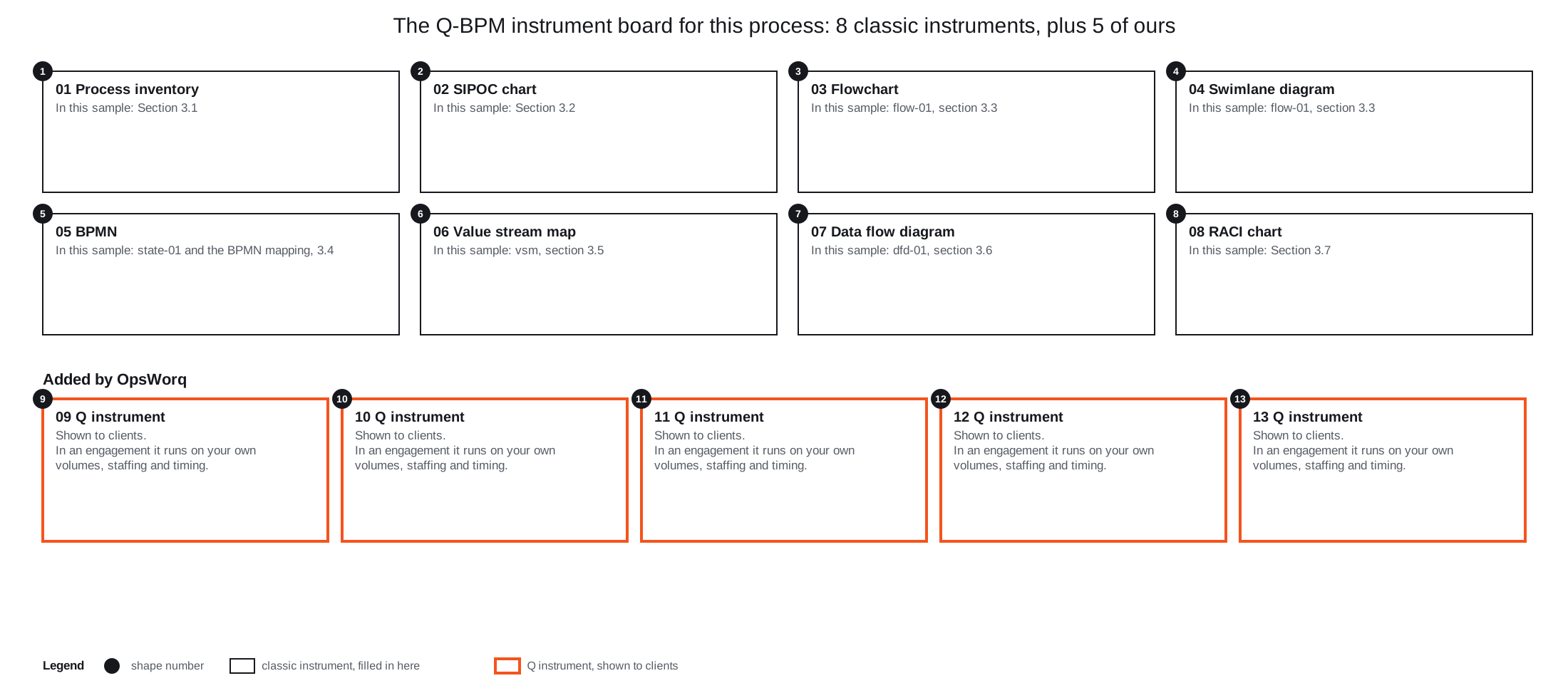
Thirteen instruments, not one.
All eight classic BPM instruments are filled in for this process. The five Q instruments are shown to clients inside an engagement.
Who does what
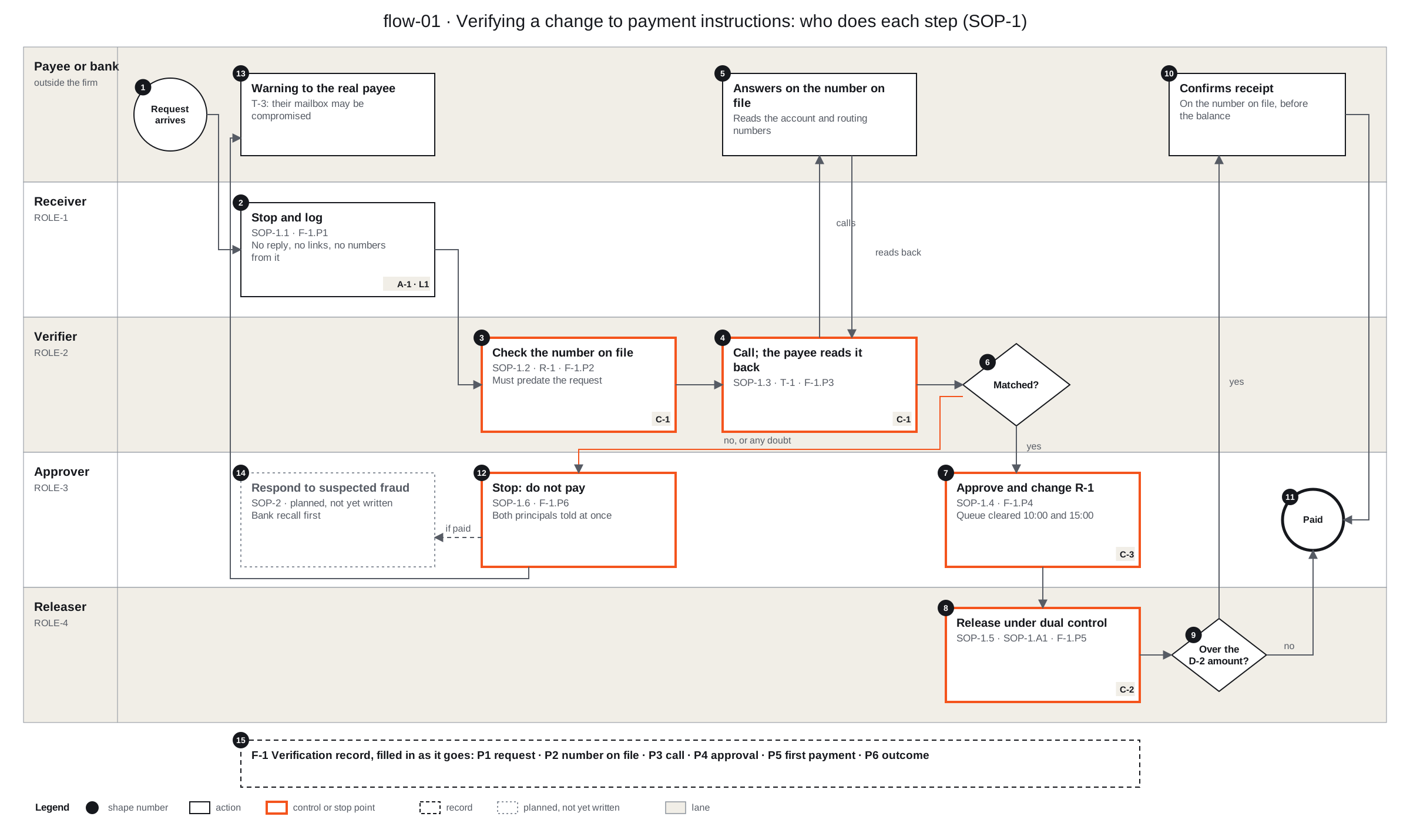
Every step, every hand-off, every stop point.
Orange marks a control or a stop point. Every shape is numbered, so anyone can point to one part: flow-01#4 is the call.
The model ran first
It found the first draft would fail.
Illustrative: a fictional firm and stated assumptions. Each figure is the average across 40,000 simulated years, then the range 95% of them fall in.
| Measure | As-is | First draft | As issued |
|---|---|---|---|
| Redirection attempts paid, a year | 5.6 (2.0 to 11.0) | 0.2 (0.0 to 1.0) | 0.2 (0.0 to 1.0) |
| Hands-on minutes per change (median; the bar is 20) | 11.0 (10.9 to 11.1) | 21.8 (21.4 to 22.2) | 18.7 (18.3 to 19.1) |
| Business hours to payable (median; the bar is 8) | 6.0 (5.4 to 6.5) | 9.0 (8.2 to 9.9) | 4.4 (4.1 to 4.8) |
The first draft stopped the redirection attempts but missed two of its own guardrails, and a procedure that misses its own bar gets skipped under pressure, which is exactly when it matters. Three changes were tested in the model, and the issued version carries them: an automation fills the number on file, payees are asked for the best time to call, and the approval and release queues are cleared twice a day.
The wiring check
535 checks. Nothing left loose.
Every instrument is a point; every reference a line. A machine walks every line before anything is filed.
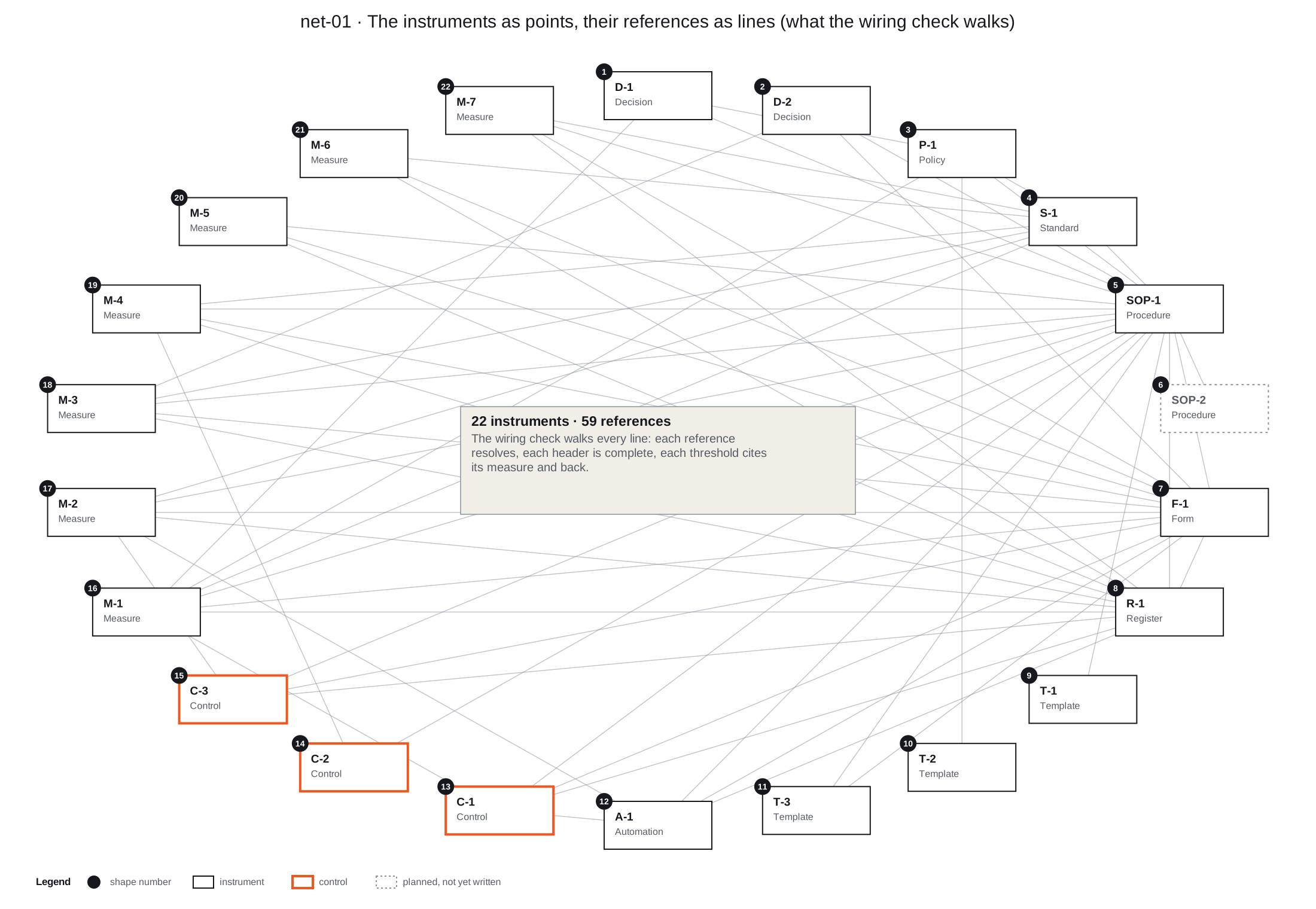
On its first run it found the notice to clients and vendors written but wired to nothing, so nobody would ever have been told to send it. The policy now requires it. That is the kind of gap a binder never shows. The two warnings that remain are honest: the fraud response procedure is planned, not yet written.
What’s inside
Thirty-four pages, one process.
- The set at a glance, and how the pieces work together
- The Q-BPM board, with all eight classic instruments filled in: process inventory, SIPOC, swimlane, BPMN lifecycle, value stream, data flow and RACI
- Every instrument in full: two decisions, the policy, the standard, the procedure and its work instruction, the form, the register, three templates, the automation, three controls and seven measures
- The ten labels for every instrument
- The trial: its target, guardrails and verdict rule, and the records the system leaves behind
- The model, its assumptions and its results
- The wiring check and its report
Questions
Questions people ask.
Is this what you would build for us?
This is one process, built the way we build every process: the instruments, the drawings, the wiring check and the model. In an engagement it is built from how your business actually runs, and the model runs on your own volumes, staffing and timing.
What are the five Q instruments?
They measure what a drawing can’t: how much, how long, what it costs, and what happens when something changes. We show them to clients inside an engagement.
Are the numbers real?
No. The firm is fictional and every input is a stated assumption, labelled illustrative throughout. The method is real: the same model, run on a client’s own records, is checked against what the business actually did before anyone relies on it.
Why do you ask for my email?
The link is sent there, which is how we know the address works. It is good for 7 days. We won’t add you to a mailing list.
The firm, its numbers and its results are fictional and illustrative. Which requirements apply depends on your organization’s facts. Legal conclusions are confirmed with your counsel. Requirements checked 17 November 2026. General information, not legal advice.
Talk to us
Want your operation built this way?
A sentence about the business is plenty. One of the principals replies within one business day.
1‑855‑OPSWORQ855‑677‑9677 · Mon–Fri, 8am–5pm ET
What can we help with?
Three short steps. A person replies within one business day.
The whole system
One layer
- IntelligenceSee it coming: the numbers on one screen, forecasts, decisions tested first.From your reading
- OperationsMake the work flow: processes, SOPs, CRM, automation and compliance.From your reading
- ContinuityNothing stops you for long: backup, recovery, and plans that have been tested.From your reading
- SecurityWhat’s yours stays yours: every login, laptop and inbox.From your reading
- Infrastructure and supportIt just works: help desk, repair, networks, Microsoft 365, phones.From your reading
Around it